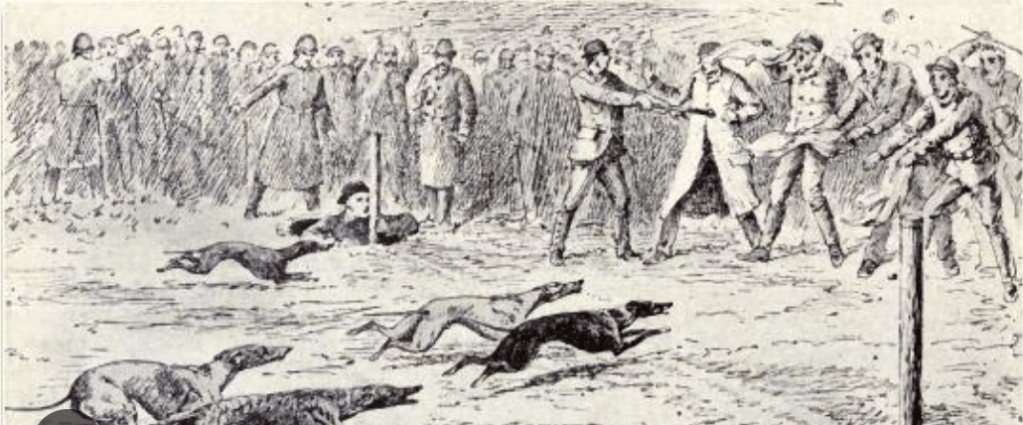
Whippet racing like so many longstanding sports is raging at the dying of the light. National institutions like cricket have had to re-invent themselves as a baseball hybrid, greyhound racing has collapsed everywhere outside of Britain and Ireland and horse racing, the sport of kings, is becoming dangerously marginalised.
To put into context whippet racing’s plight, there are perhaps just 150 true racing whippets competing in Britain at present as compared with around 2000 in the 1970s.
The sport has a long and, some would say, chequered history. Newspaper reports of whippet races go back into the 1800s, as far as the British Newspaper archive can document. For the record, the first greyhound race was at Belle Vue in 1926. Whippet racing’s modern day peak was in the sixties and seventies, but it was probably bigger in the decade before both world wars. It was the miners’ recreation of choice and in 1913 there were 2,600 coal mines in Britain employing over one million people. Even in the 1950s there were 1,400 coal mines in Britain. It wouldn’t be incredulous to say that 1% of miners owned and raced a whippet meaning that there would have been about 10,000 racing whippets in Britain at one time. In the 1970s there were about 60 or so clubs reporting results to Whippet News with an average of about 30 dogs at each meeting, meaning there were at least 2,000 whippets racing.
In truth, the sport has been in free fall since Margaret Thatcher did for the mining industry in the 1980s. By the millennium the number of dogs racing was probably down to six or seven hundred and many clubs became places people trained their dogs for open races rather than places they raced their dogs. Today, only about a fifth as many clubs and dogs race as they did 25 years ago.
Socio-economic changes may have shot a broadside at the sport, but like horse and greyhound racing it has also contributed to its own demise. Horse racing continues to battle the vested interests of its stakeholders and is contracting as they fail to rally behind a unifying cause and whippet racing has had much the same issue.
The beginning of fragmentation in whippet racing came when the owners of pedigree whippets decided to race only against each other, forming their own association in 1968 and excluding the racers that were not Kennel Club registered. Over time this has given rise to the original racing whippet being referred to as non-pedigrees, though with lineages documented back a dozen generations into the forties and fifties this is an unnecessarily demeaning term that acts against the interests of the sport popularising itself. It would be more accurate to describe the breeds as fast racing whippets (the non-pedigree dogs) and slow racing whippets (the Kennel Club registered dogs) since the former are on average 20% faster than their show-derived cousins.
It speaks to the self-deprecation of the working classes that invented whippet racing that they have deferred to the middle-classes, who broke away from the core of the sport to race Kennel Club registered dogs, when it comes to labelling their sport and their dogs. It is ironic and sad that at a time when the whippet as a breed is more popular than ever, that the original racing whippet is rocketing headlong towards extinction. That is not helped by the closed shop operated by breeders of original racing whippets of not selling pups to people from outside the sport.
Fragmentation continued when a group of racers railed against the sport being governed by the British Whippet Racing Association and in the mid-seventies created a second organisation called the National Whippet Racing Federation. And has galloped along unfettered ever since. Where once all whippets raced in one event (Kennel Club registered or not), handicapped at one yard for each pound heavier they were, they are now fragmented into so many classes that at most events as many as two-thirds of the classes attract just one entry. First dogs were separated from bitches, then the entries divided into two, then four, then six weight-classes, then pups given their own class and then veterans theirs and then yearlings theirs and then the introduction of a maiden section for dogs that had not won an event and then a timed event for the slower dogs.
Each new section is intended to help more dogs have a chance of winning and has been well-intentioned, but has made the sport unexciting to watch, less competitive and more difficult to understand. It has helped more dogs “win” though largely when racing on their own and has made a day’s racing interminably and unnecessarily long.
The sport is floundering into history and unsurprisingly many of its passionate participants are not going gentle into that good night. You can’t help thinking though that they are proposing measures to re-invigorate the sport without giving much thought to as to what ails it and what caused its ailments in the first place.
Presumably if you want slow down the stream of people discontinuing racing it would help to know why those that have stopped racing did stop. Perhaps because their dog got old, because they got sick of the same few dogs winning, because a day’s racing became too long, because they’d seen it and done it, because they couldn’t buy a competitive dog, because they felt the sport wasn’t fairly run?
And if you can stem the flow of people leaving the sport how then do you get new people to engage with it?
Is it really that surprising that in our vainglorious modern world that nobody wants a dog called a “non-pedigree”, when what at one time would have been an accidental mongrel is now a fashion accessory called a Cockapoo or Labradoodle? As they say, give a dog a bad name, and whippet racing has certainly won first prize in that little competition.
That of course is if it were even possible to buy a racing whippet, since only a handful of existing participants in the sport ever know when a litter is bred.
Is it also that surprising that nobody aspires to racing a whippet given that virtually no-one has ever seen the sport and would find it virtually impossible to find out when and where an event was taking place? And even if they did stumble upon it, would even the world’s greatest thinkers be able to understand what was going on?
And if by some quirk of chance they managed to buy a racing whippet and take it to an event would they want to continue having set-off for the event at 7am, waited until 1pm for racing to start, watched dozens of solos before finally getting a solo themselves at about 3pm and then waiting until 5pm to receive the trophy for winning the puppy open in which they were the only entrant before embarking on a three-hour drive home?
So if the light of whippet racing is not to die, the events need to become easier to understand, a better spectacle for the viewer, more convenient for the participants and easier to engage with.
It would be no bad thing to start by giving the dogs a name that does not demean them, a breed people might aspire to own – Racing Whippet perhaps! Then create a format of racing that de-fragments it to ensure the dogs are racing not solo-ing, one that is simple to understand and offers dogs of all abilities, genders, ages and weights a chance to win a race. De-fragmenting events will make them more convenient for participants by shortening the racing day as dogs are consolidated into fewer races with more runners, make the racing easier to understand and easier to program.
Consider a pre-entry 25 dog stake arranged as an ABCDE event of five x five dog races in which dogs, veterans and pups receive allowances. Ten races could be run at 10 minute intervals facilitating a known timetable of races that could be associated with streamed video of the racing on the Internet. In less than two hours the event would be concluded and its existence streamed live to thousands watching online. With a weigh-in at 10am, the racing could be started at 11am and concluded by 1pm. The watching audience would even know what time races were going to start. It might even offer the opportunity for a second event with the dogs redrawn starting at 2pm after a lunch break and finishing at 4pm.
A simple, fair and marketable format that is convenient for participants. Who knows, if people can actually watch the sport live on their mobile or tablet at home and come to aspire to own one of this elite breed of gladiators they might actually start racing. It is just a thought!

 Barnyarder's Blog
Leave a comment