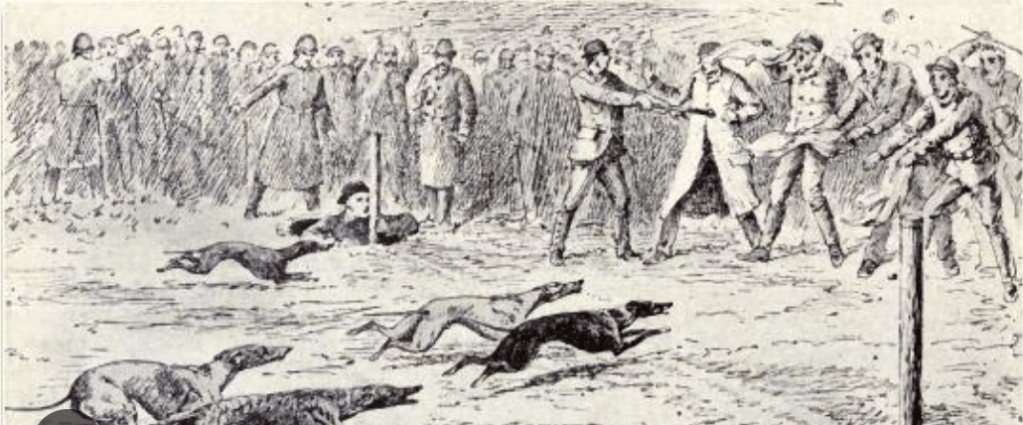
Whippet racing like so many longstanding sports finds it popularity in decline. It is not alone of course, horse and greyhound racing have their own crises and even sports which are not analogous such as cricket has had to re-invent itself as a baseball hybrid to remain relevant.
The whippet itself represents a cameo of Britain’s class system. Whippet racing was the sport of the working classes, of miners, steel workers and dockers. It was frowned upon by the middle-classes as a corrupt betting sport. Simply taking a handful of racing whippets in the late 1800s, interbreeding them and getting Kennel Club recognition for them as a breed whose purpose was not racing but showing was enough to make the whippet acceptable to the middle and upper-classes, Kennel Club-registered whippets at least. The original population of whippets used for racing however continued and today we have two strains of whippet, the Kennel Club-registered dogs and those not registered with the Kennel Club whose sole purpose is to race. The latter are unknown outside of the community that races them, the former are of course now widely recognised as the pedigree whippet.
It seems though, if you have a whippet it is hard to resist finding out how fast it can run and consequently the small sub-population of whippets that became the Kennel Club-registered whippet and were intended for showing were soon tried on the race-track. At one time races involving Kennel Club-registered dogs and the wider population of whippets were the norm. This started to come to an end after the Whippet Club Racing Association (WCRA) was formed in the late sixties to organise racing for Kennel Club-registered dogs only. A move in response to the earlier formation of the British Whippet Racing Association (BWRA) that looked to oversee racing for all dogs of whippet type, Kennel Club-registered or not. It means that today we have two forms of whippet racing and two strains of whippet. One Kennel Club-registered, the other BWRA-registered, although the latter embraces both strains in reality.
The drift of British society from working class to middle class, partly resulting from the closure of the mines, the docks and the steelworks, has resulted in the community that kept whippets for racing dwindling enormously and the BWRA racing strain is in truth becoming endangered. Ironically, this has occurred against a backdrop of the Kennel Club-registered whippet becoming hugely popular to the point of being a fashion accessory.
It is hard not to think that elitism has led us to where we are now. On the one hand many owners of Kennel Club-registered dogs dismiss BWRA-registered dogs a “not real whippets” because their pedigrees include outcrosses to greyhounds and on the other owners of BWRA-registered dogs consider Kennel Club-registered dogs as inferior because they are slower.
The most damaging elitism though has been practised by the community racing BWRA-registered whippets who largely refuse to sell dogs to anything but proven racing homes. In essence, the BWRA racing community has been a closed shop of ever decreasing membership for decades while the WCRA racing community has welcomed owners of whippets sold to them as pets that fancied racing their dogs. One has become a tiny group that has ring-fenced a tiny number of elite dogs and the other has burgeoned into a sport with more participants, albeit one slower ones.
Just for clarity I should point out that I have used the terms BWRA community and WCRA community for convenience. Whippet racing would not be whippet racing without division and so both communities now have more than one organisation representing them. I have also done so to avoid distinguishing the two branches of racing as non-pedigree and pedigree. Strictly speaking all whippets that race today can be said to have a pedigree since both BWRA-registered dogs and Kennel Club-registered dogs have traceable ancestries.
Whilst on the subject, it really needs pointing out that the whippet as a concept existed well before the Kennel Club recognised it as a breed. The first use of the term in literature is back in the 1500s and it seems almost certain that it was a term that came into usage to describe small dogs of greyhound type. The BWRA has, knowingly or not, continued that usage by requiring dogs only to be of whippet type in order for them to be accepted for racing. Out-crossing of BWRA whippets to greyhounds is common and genetically speaking is almost certainly only crossing two dogs of a different size that are of the same genetic group. Obviously Kennel Club-registered dogs started their ancestry, not much over a hundred years ago, with the same gene pool. Indeed genomic analysis of Kennel Club-registered whippets and greyhounds show that unsurprisingly they belong to a single genetic group and share a near identical ancestral gene pool. The point is that scientifically the only thing that distinguishes a whippet (any whippet) from a greyhound is size and the historically accepted name for a small greyhound is whippet whether it has a Kennel Club passport or a BWRA one. The fact is that there are whippets and a sub-population of Kennel Club-registered whippets. Genetically, they are probably less different than Africans and Europeans.
Size of course is an interesting delineator between a greyhound and whippet. At what size does a whippet become a greyhound? The BWRA and WCRA essentially decided that it was at 32lb and it is worth remembering that the smallest winner of the Waterloo Cup, the historic and pre-eminent hare coursing competition for greyhounds, was Coomassie who weighed just 42lb. I doubt you will find anybody that accepts that Coomassie was really a whippet, so it follows that it is hard to justify calling dogs over 40lb whippets, they may be smallish greyhounds but they are not really small enough to be called whippets. It is somewhat ironic then that there are quite a lot of Kennel Club-registered whippets that weigh more than Coomassie did. It is also oft suggested that a whippet came about by crossing greyhounds with terriers. Clearly there is some merit in that argument, but the idea that terrier blood is exclusive to whippets and does not exist in greyhounds is clearly not true. Lord Orford out-crossed his coursing greyhounds to bulldogs to improve their gameness and over the millennia that the greyhound has evolved he will not have been alone in such an endeavour. The Greyhound Stud Book wasn’t published until 1882 and it is only since then that the greyhound type has become the greyhound breed. The most accurate way to define a whippet is to say that it is a type of small greyhound.
The question for the community that own BWRA-registered whippets is where do they go from here to ensure their strain of whippet and their sport can flourish once more.
It is of course not all doom and gloom as some would have it. The sport’s biggest events such as the English and Scottish Derbys represent not only the pre-eminent test of the breed as a race-dog but remain exceptionally well organised, well funded and well contested events that would have graced any era of the sport. And there are a dozen or so events throughout the racing calendar of similar stature.
The sport was floundering into history and unsurprisingly many of its passionate participants are not going gentle into that good night. 2025 may have been the an unsuccessful attempt to address some of the sport’s issues, but in 2026 it has unquestionably shown the green shoots of recovery. The again separated BWRA and NNWRF (the extra N stands for “new”), which briefly merged unsuccessfully in 2025 are both re-invigorated. They, alongside independent race organisers like the teams at Old Hall WRC, Kings Park WRC, Kirkcaldy WRC and Bilsthorpe WRC which all run heavily sponsored Classics opens and Whippet News, which now runs one of the sport’s biggest events, the English Whippet Derby, have brought new energy to whippet racing’s biggest meetings. The Derby boasted £3,500 in prize-money, electric timing and attracted 142 dogs who competed over two days for the right to be called “The” Derby winner.
Plenty of older racers mourn the passing of the sport as it was fifty years ago, but the sport no longer has a hinterland made up of miners, steel workers and dockers. That said, at its core the sport’s appeal is as it ever was. There is very little to compare with the dog you’ve reared from a six week old puppy, that sleeps on your bed, that your every waking hour is occupied by thoughts of how to make run faster, that you’ve walked up the track and shouted home, winning a good race. When you are so invested in a dog, it becoming a Supreme Racing Champion or winning the Derby (either Derby) is akin to scoring the winning goal in the Cup Final. Almost without exception everybody who comes into the sport soon dreams of that dog and that day. In itself it makes the sport addictive, for all that it is usually run on a bit of grass up the side of a football field and not at a stadium in front of tens of thousands of appreciative spectators.
The fact is that you don’t have to be a miner or a steel worker to get what that means. It is probably true to say that whippet racing has never been more acceptable to the wider public than it is today and whippets themselves have never been cooler.
time moves on and trywhat passed as acceptabGreen shoots of course need nurturing and outstanding though the Derby was, it was not the perfect advert for the sport. Given the huge entry the Derby attracts the many sections other than the main event do work in providing opportunities for lots of dogs other than those trying to win the Derby itself. The paucity of lightweight dogs entering though did make some of the classes unworthy of the sport’s blue riband. There is also the issue of running events to an agreed time schedule. Everybody had to wait seven hours for the two biggest races on the first day featuring the Derby favourites. Worse though, not even those involved knew quite what time those races would take place. That makes it impossible to promote the sport to a wider audience because you simply cannot tell them at what time they should be watching. Even the Derby final on the second day was not afforded an actual time-slot.
It was a shame because there was considerable local interest in watching the racing even though the sport did little to engage the local community or furnish them with a program of races when they happened upon it. Whippet racing still needs to make itself more convenient for the participants and more accessible to onlookers.
Apparently, the Derby will be run at Old Hall WRC next year in a joint celebration of the club’s 60th year and the Derby’s 30th. Laudable though that is, one can’t help thinking that the event can do more for the sport run at Fordingbridge in the New Forest. The Fordingbridge track is not as good for racing or watching racing as Old Hall but it is better-placed to advertise the sport to potential new entrants. The park and river adjacent to the track are always alive with people undertaking various forms of recreation, many of whom wander over to watch the whippets race. That is just not going to happen at the Church Gresley Community Centre.
Whippet racing has made a good start to its rehabilitation after reaching its nadir just after Covid. There remains plenty to do however.
It would be no bad thing to start by giving the dogs a name that does not demean them, a breed people might aspire to own – either simply Racing Whippet or Race-Bred Whippet would suffice! Emphasis also has to be placed on ensuring competitive racing as opposed to creating classes with just one entry in a misguided effort to give everybody a winning chance. Consolidating dogs into less weight-classes will make events more convenient for participants by shortening the racing day, simply because there will be fewer races with more runners, and make the racing easier to understand and easier to program. Most events run in weight-classes would do better with just lightweights and heavyweights. Either with dogs and bitches separate to create a four-dog final or dogs given a gender allowance and the first two progressing from the lightweight and heavyweight final to an overall final. This would ensure competitive racing, decrease the likelihood of the same dogs being drawn against each other in the first round of every event and reduce the number of races on the card. An alternative format which is equally efficient might be for all dogs to race in one class but with a gender allowance. Successive rounds can then see the dogs either graded into ABCDE based on where they finished in their heat or into main event and consolation/second chance events. It would seem the fairest handicapping format is that used by the Derby of 2 feet per pound, 160y back dog since it gives whippets of all weights a roughly equal chance of winning.
A simple, fair and marketable format that is convenient for participants is what is needed. If onlookers could contextualise and actually understand what they are looking at they might want to participate.


Leave a comment